Top Events, August 24–28: Nvidia's Report, PCE Inflation, and the Fed Chair's Speech at Jackson Hole
The Big Picture
The week's headline event is Nvidia's earnings report on Wednesday. The stakes are doubly high. First, the company has fallen into a repeating pattern: its shares have dropped after each of its last three quarterly reports — even when the numbers beat forecasts. It isn't about weak results; it's about elevated expectations — the bar is set so high that even strong numbers regularly fail to satisfy the market. Second, Nvidia's fortunes are, quite literally, a proxy for the entire AI cycle: according to Wedbush estimates, every dollar of the company's revenue corresponds to another $8–10 in spending on other technology — chips, memory, storage, energy infrastructure, and even construction equipment. These investments are now so large that the Fed itself is tracking their effect on inflation. The company had a busy summer: CEO Jensen Huang unveiled a new chip built for AI agents running on-device, the company made progress selling chips in China, and it signed deals to help finance the construction of AI data centers. Shares are up 15% since the start of 2025, though they've pulled back from their May highs.
The week's second-most-important event is Fed Chair Kevin Warsh's speech at the Jackson Hole symposium on Friday. Interest is running high because the Treasury's recent announcement of an intervention in the bond market, along with a rapid rise in corporate borrowing, has drawn close attention to long-term yields — according to CNBC, Warsh may specifically address the state of the economy and how the Fed is engaging with the bond market.
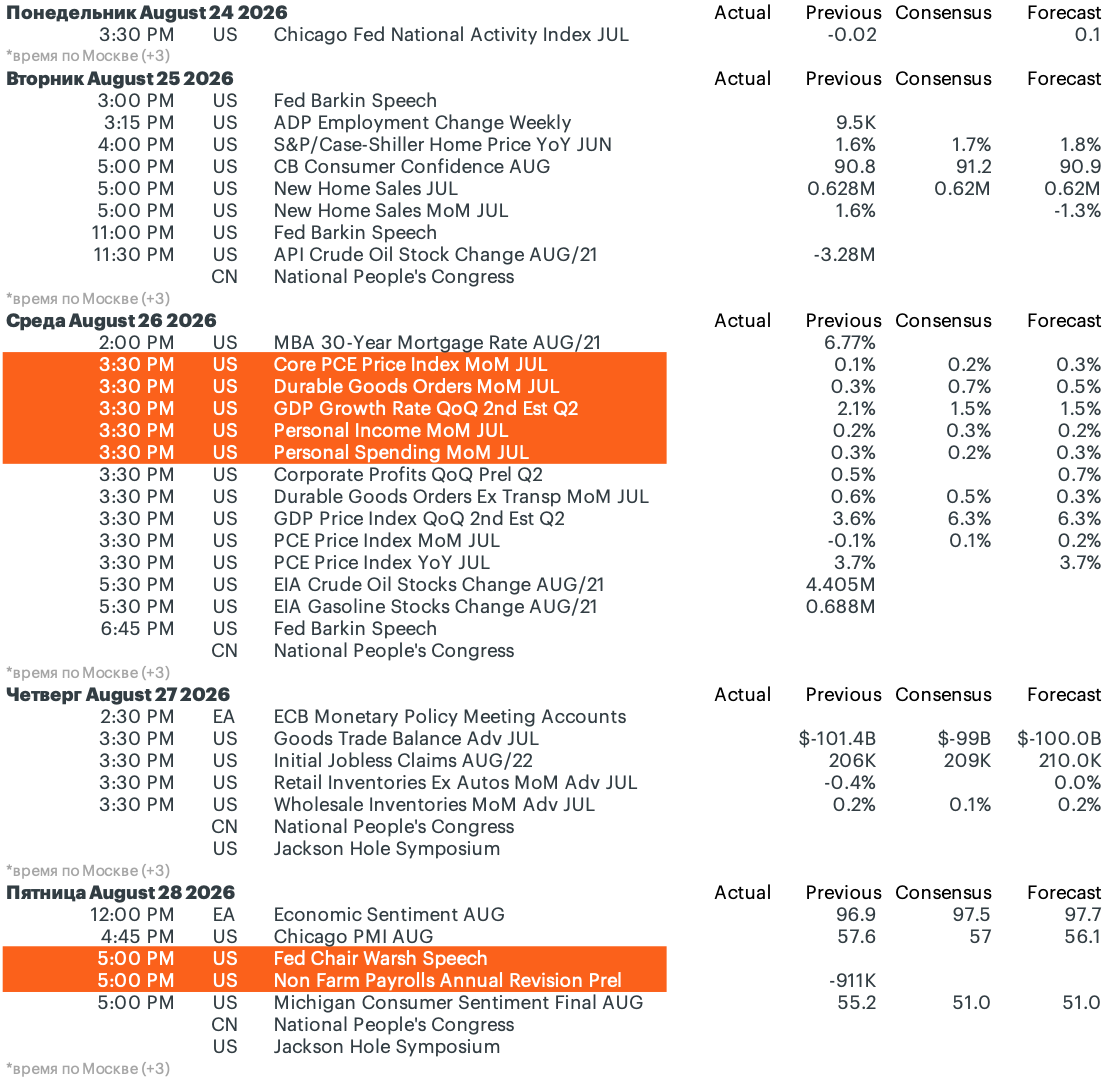
Wednesday also brings July's personal consumption expenditures (PCE) index — the Fed's preferred inflation gauge, unlike the CPI and PPI, which have already been released. Rounding out the picture: personal income and spending data, durable goods orders, the second estimate of second-quarter GDP, and the annual benchmark revision to nonfarm payrolls.
On top of that, a long list of retail and software companies report this week — from discounters to beauty retailers to apparel makers — so the picture on both the consumer and the broader business landscape should come through fairly complete.

Forecast for the U.S. key interest rate for the week ending August 17–21 (current rate: 3.75%)

Forecast for the U.S. key interest rate for the week ending August 10–14
This Week's Economic Data
Macroeconomic calendar of key events for the week
Personal Income and Spending, PCE (Wednesday, August 26): personal income is forecast to rise 0.2%, spending 0.3%. The headline PCE price index is expected at +0.2% month over month, the core index at +0.3%; on an annual basis, headline PCE is forecast at 3.7%. This is the Fed's preferred inflation gauge — unlike the CPI and PPI, which have already been released.
Second-quarter GDP, second estimate (Wednesday): consensus is 1.5% annualized, matching the initial estimate.
Durable goods orders (Wednesday): expected to rise 0.5%.
July goods trade balance (Thursday): consensus is near −$100 billion.
July wholesale inventories (Thursday): a modest increase of 0.2% is expected.
Housing market (Tuesday): July new home sales — consensus 0.62 million; the S&P/Case-Shiller home price index for June — consensus +1.8% year over year.
Labor market (Friday): the annual benchmark revision to nonfarm payrolls, covering the period through March 2026.
Fed Chair Kevin Warsh's speech (Friday): Fed Chair Kevin Warsh speaks at the Jackson Hole symposium — markets are watching for signals on monetary policy and the Fed's stance on long-term yields, against the backdrop of the Treasury's recent bond-market intervention and rising corporate borrowing.
Earnings Calendar
Tuesday, August 25
- Intuit [INTU] — the parent company of TurboTax and QuickBooks; beat expectations last quarter but also announced plans to cut staff.
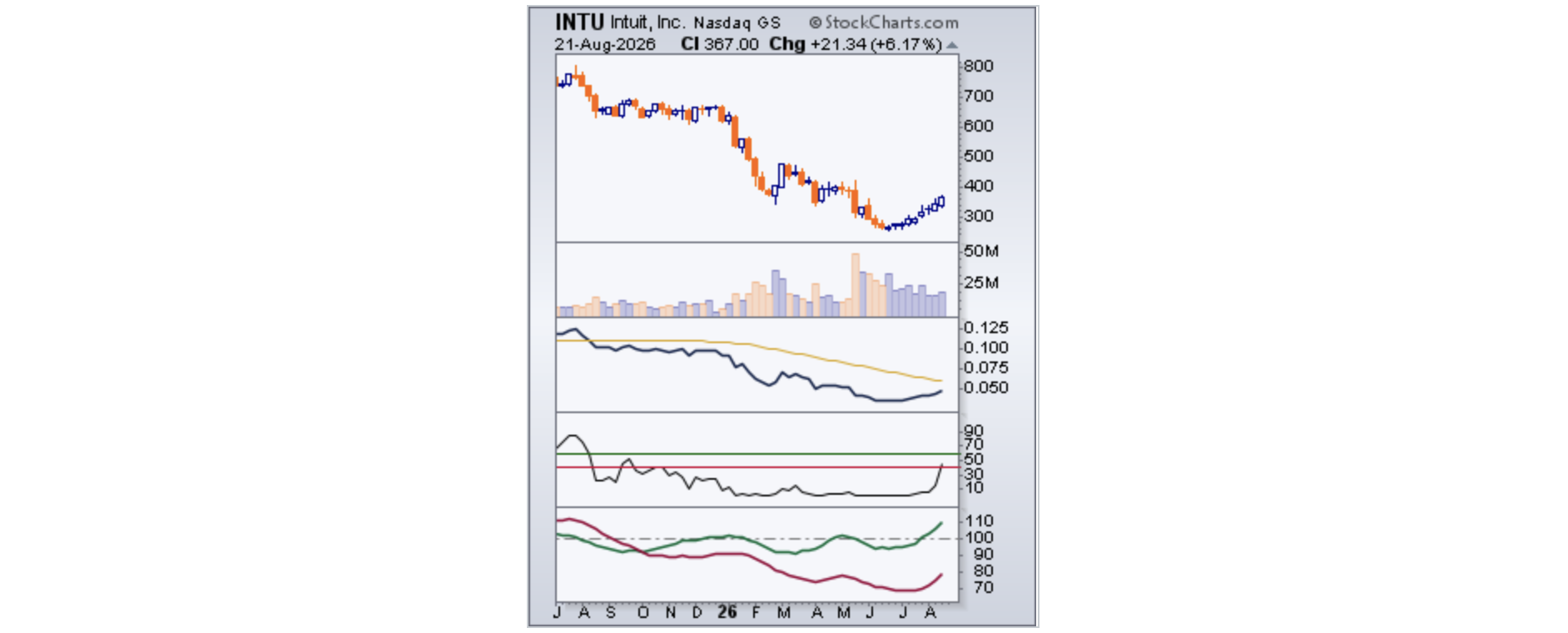
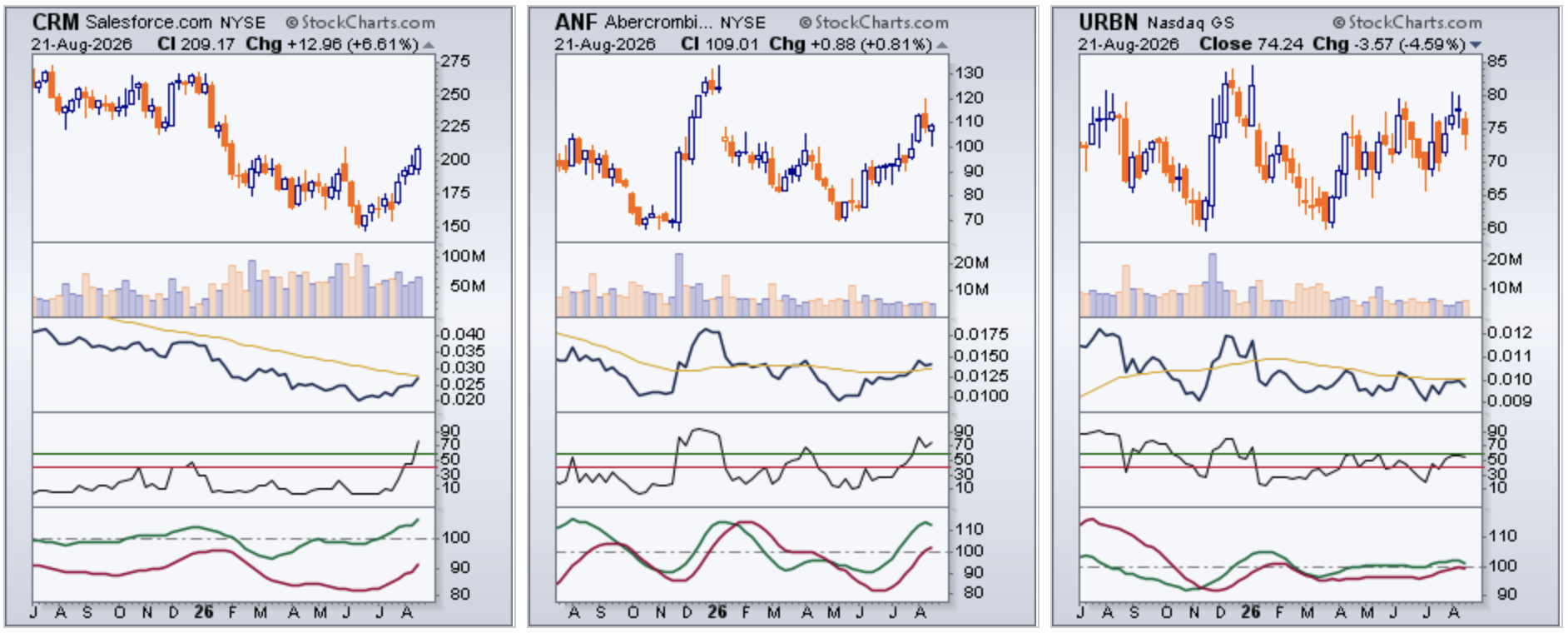
Weekly chart. Third box — the stock's relative strength vs S&P 500 [SPX]; fourth — SCTR technical rating; bottom box — RS-Ratio and RS-Momentum components for the Relative Rotation Graph (RRG) vs S&P 500 [SPX]
Wednesday, August 26
- Nvidia [NVDA] — the maker of AI chips and the world's most valuable public company.
- Kohl's [KSS] — a department store chain; earlier this year it leaned into sub-$10 items and heavy in-store discount promotion as part of a turnaround campaign launched in 2025 amid the success of discounters like Burlington.
- CrowdStrike [CRWD] — a cybersecurity company that beat expectations last quarter. Analysts believe the growth of AI is boosting demand for cybersecurity software broadly.
- Salesforce [CRM] — one of the largest enterprise software makers (CRM systems); posted strong results last quarter, but guidance disappointed investors.
- Abercrombie & Fitch [ANF] — an apparel retailer and Gap competitor.
- Urban Outfitters [URBN] — an apparel and home-goods retailer aimed at younger shoppers.
- Bath & Body Works [BBWI] — a chain of scented personal-care and home-fragrance stores.
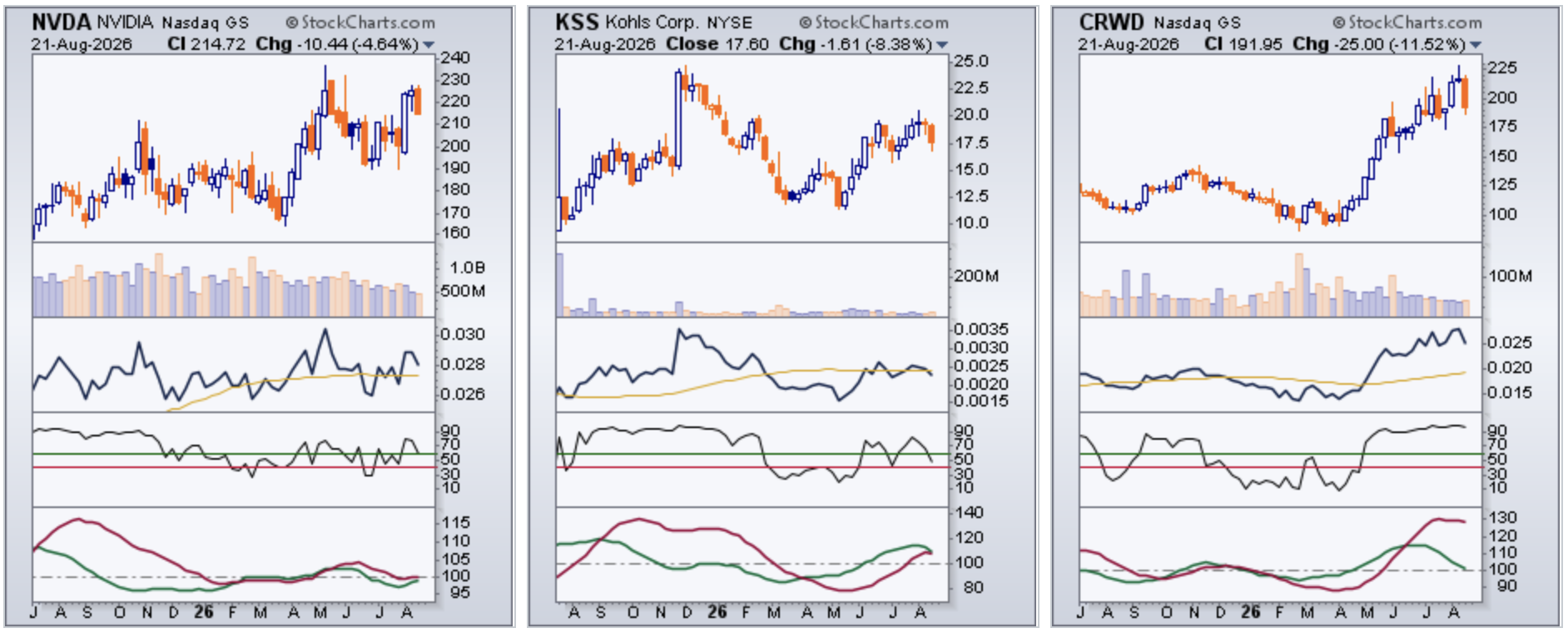
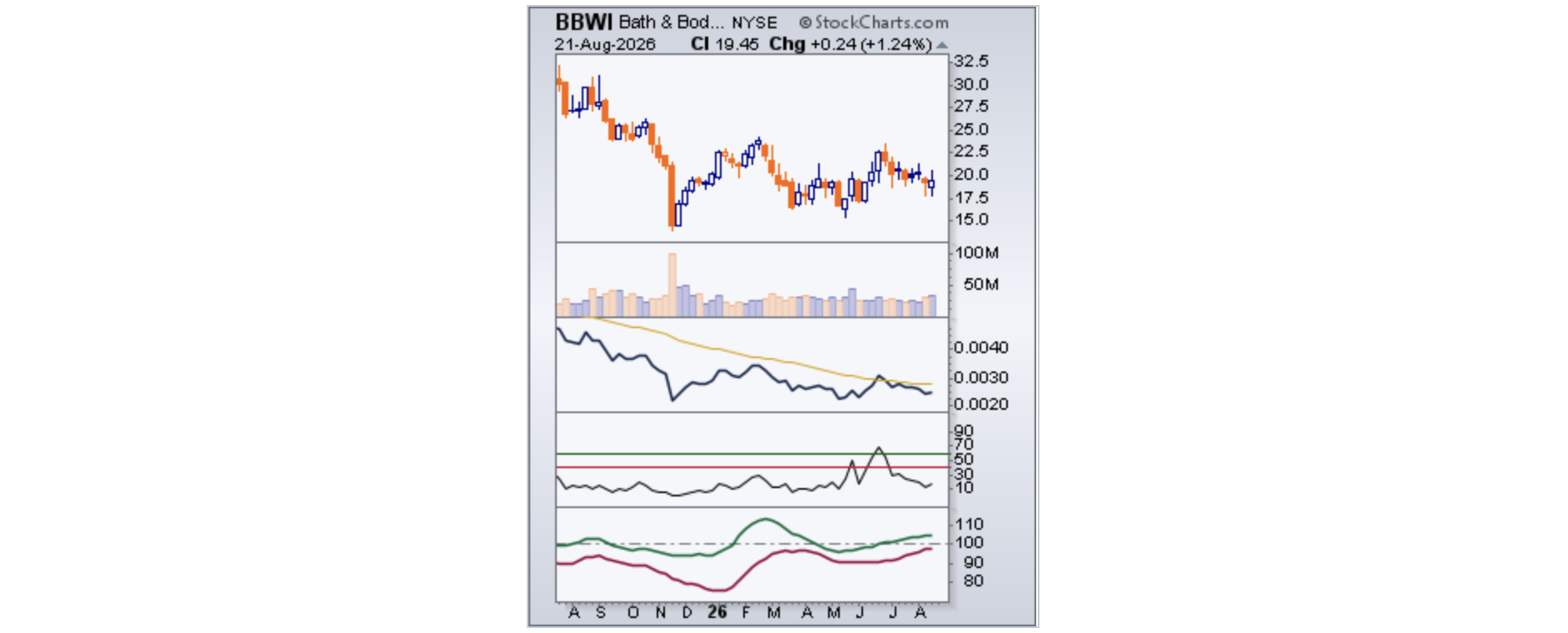
Weekly chart. Third box — the stock's relative strength vs S&P 500 [SPX]; fourth — SCTR technical rating; bottom box — RS-Ratio and RS-Momentum components for the Relative Rotation Graph (RRG) vs S&P 500 [SPX]
Thursday, August 27
- Best Buy [BBY] — the largest US electronics retailer; navigating a leadership change and has launched a digital marketplace to revive sales.
- Dollar General [DG] — a discount retail chain that beat profit expectations last quarter and raised its guidance.
- Dollar Tree [DLTR] — another major discount retail chain.
- Gap Inc. [GAP] — parent of the Gap brand as well as Old Navy and Banana Republic; cut guidance last quarter.
- Ulta Beauty [ULTA] — the largest US beauty retail chain; its stock has fallen after every report so far this year.
- Marvell Technology [MRVL] — an AI chip designer recently added to the S&P 500; praised by Nvidia's Jensen Huang, who said Marvell could become "the next trillion-dollar company."
- Burlington Stores [BURL] — a discount apparel and home-goods chain.
- SentinelOne [S] — a cybersecurity company and CrowdStrike competitor.
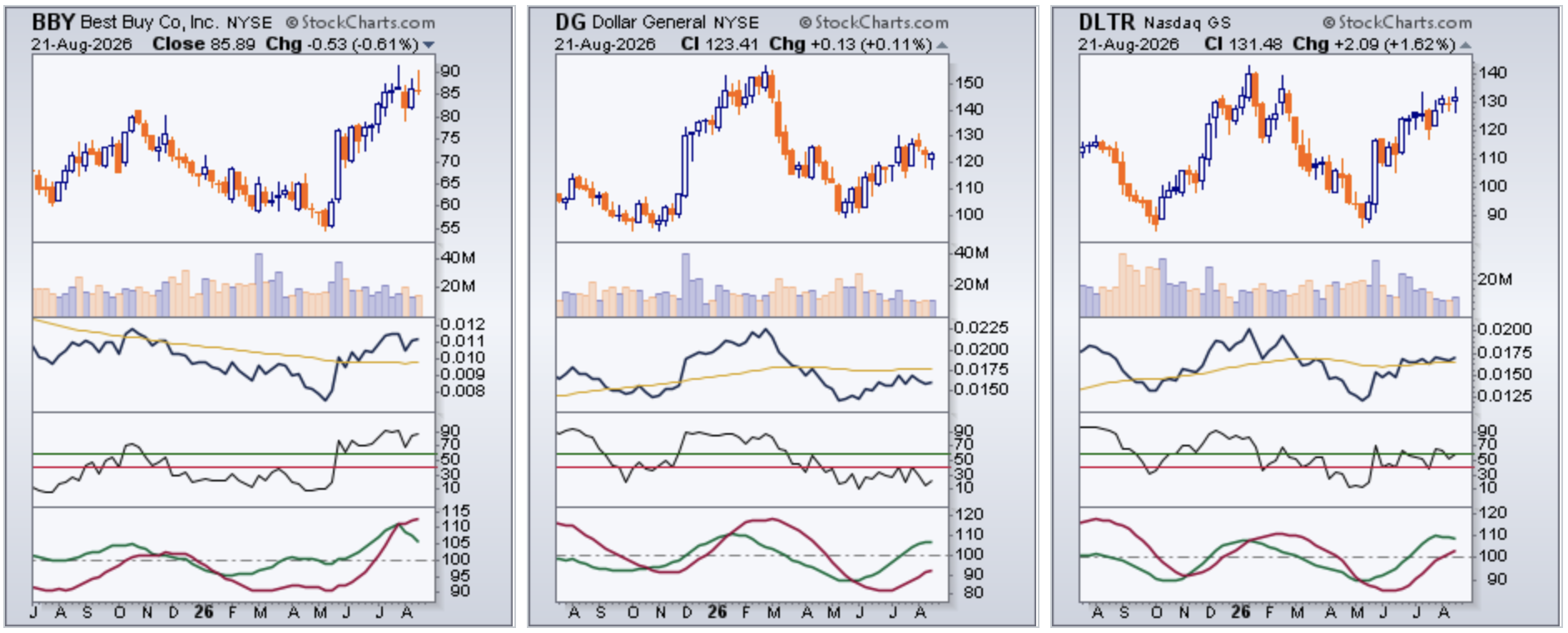
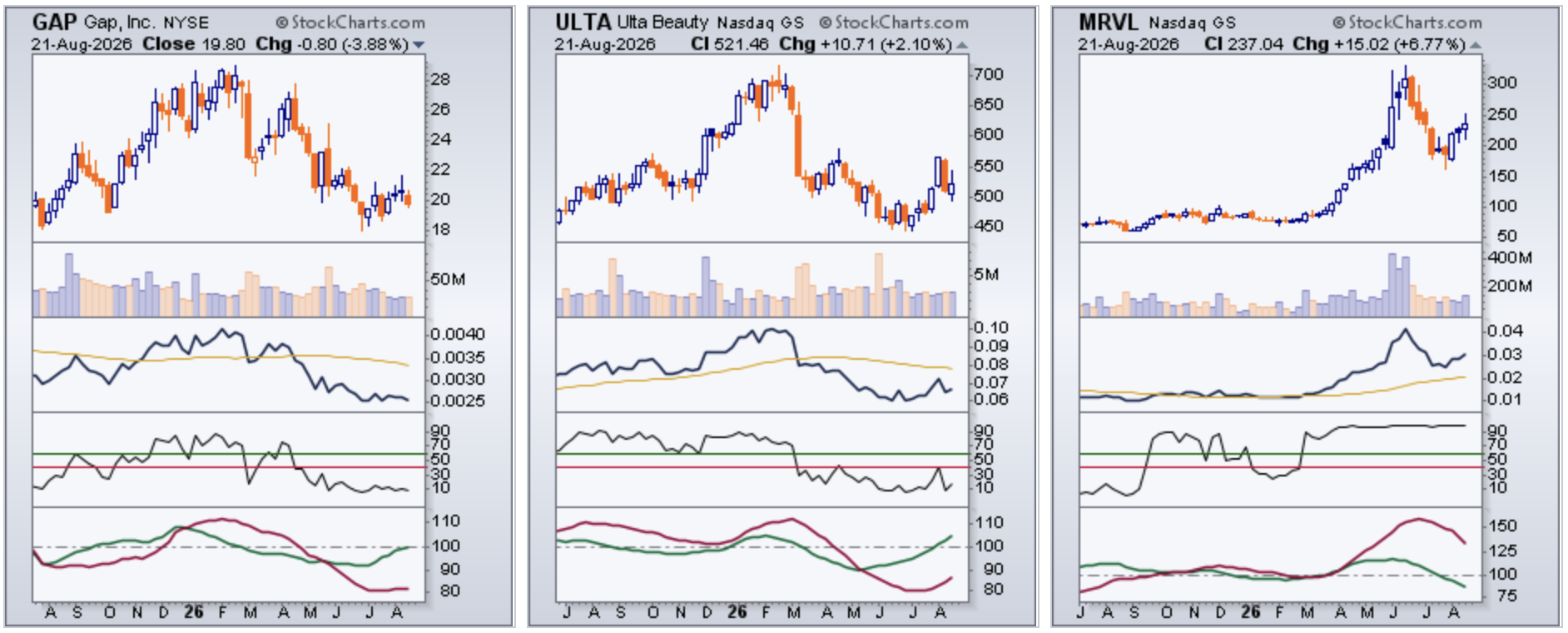
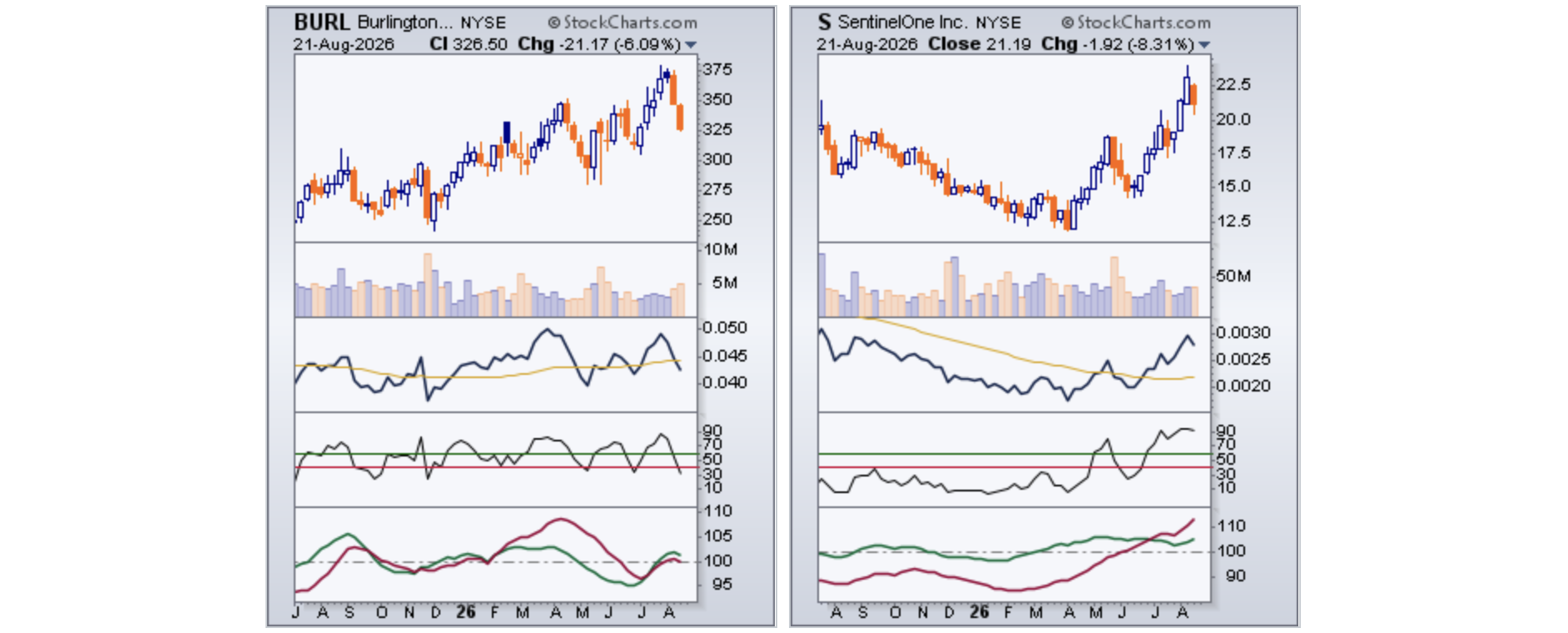
Weekly chart
Last Week's Close
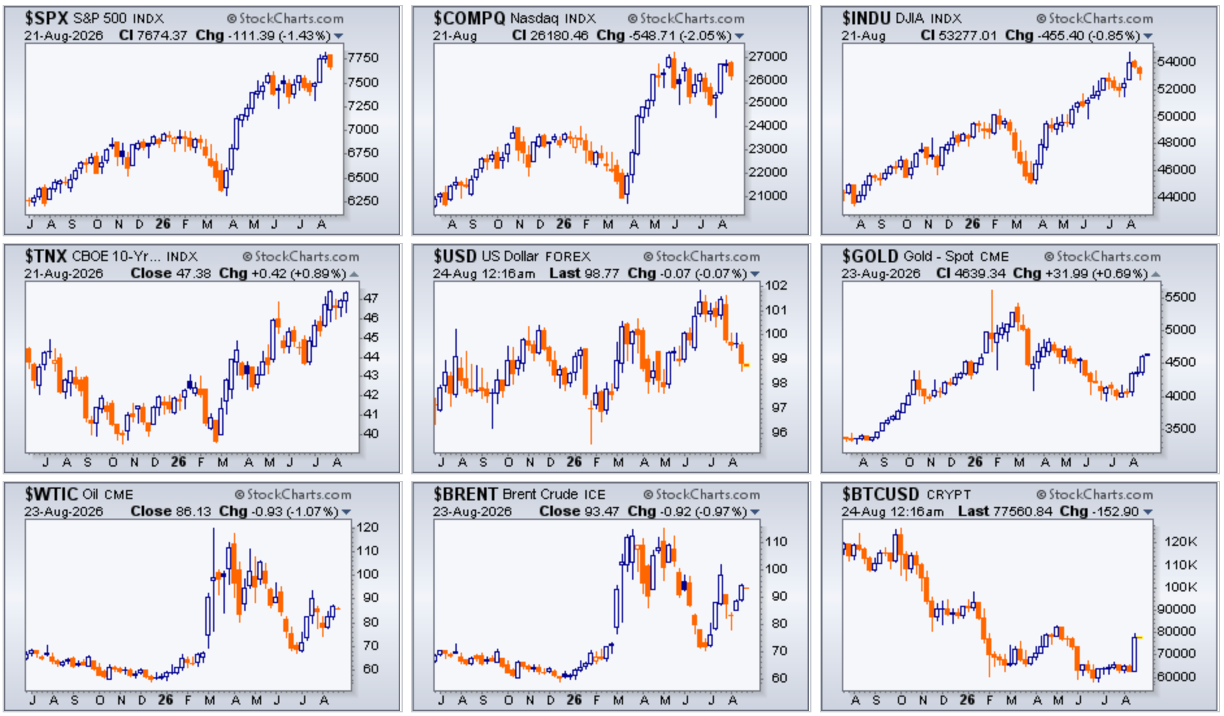
Despite Friday's gains, the S&P 500 and Nasdaq Composite snapped a three-week winning streak: for the week, they fell 1.4% and 2.1%, respectively, while the Dow dropped 0.9% — its second straight losing week. Investors kept a close eye on bond yields amid growing doubts that the US and Iran can reach a deal: the 30-year Treasury yield hit levels not seen since 2007, though it briefly reversed lower after the Treasury announced an increase in long-term bond buybacks. Walmart stood out: shares lost more than 10% for the week after a rare earnings miss. More details in Friday's after-hours recap [link to be added after publication].
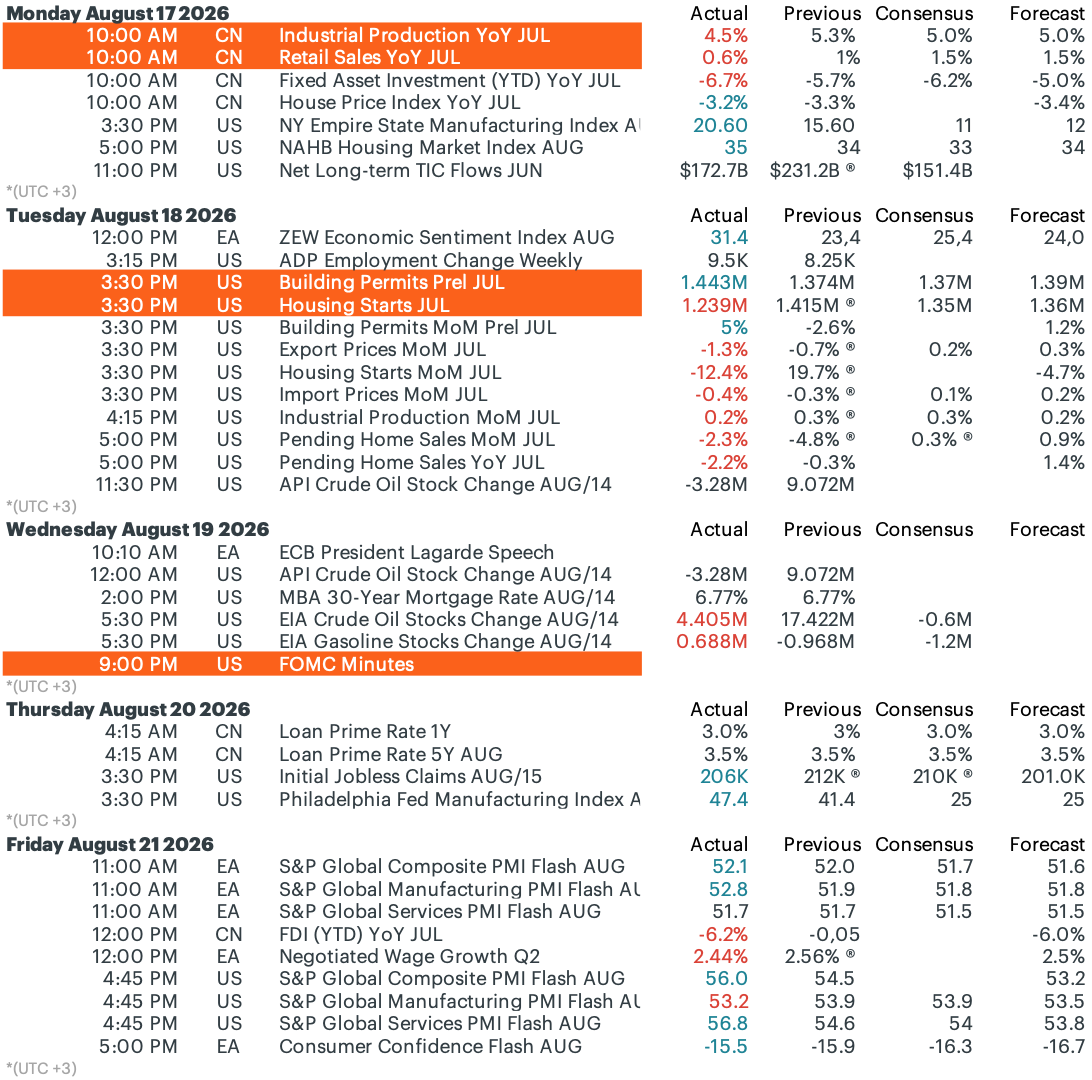
Macroeconomic calendar of key events of the last week
Back to homepage: weknow.market
Sources: TradingEconomics, Investopedia, FedWatch, StockCharts
Author: Igor Gurevich, laurels.team
Author: Igor Gurevich, laurels.team